
 Factory Automation
 Logistics Automation
 Process Automation
 Crane Collision Avoidance
 LiDAR Sensors
 Safety Laser Scanners
 Optical Data Transmission
 Hot Metal Detectors
 Laser Distance Sensor
 Blog
Blog Whitepapers
 Case Studies
 Infographics
When people hear the term wireless communication, they often think of Wi-Fi or Bluetooth. In industrial automation, however, there is another approach designed specifically for demanding manufacturing environments: Optical Data Transmission.
Rather than relying on physical cables or radio frequency (RF) communication, Optical Data Transmission uses infrared light to transfer data between moving and stationary equipment. As automation systems become faster, more connected, and increasingly mobile, traditional cabling can introduce maintenance concerns, mechanical wear, and integration challenges that impact long-term operational performance.
Facilities that rely on trailing cables, cable carriers, or slip rings often face hidden costs associated with routine maintenance, component wear, and unexpected downtime. As a result, many manufacturers are evaluating non-contact communication technologies, including Hokuyo's Optical Data Transmission solutions, to help improve system reliability while reducing mechanical complexity.
Let's explore why traditional wiring can become a limitation in modern automation environments—and how Optical Data Transmission is helping manufacturers build more reliable, efficient operations.
Breaking the Cycle of Mechanical Wear
One of the biggest challenges with traditional wired communication is that the cables move. In applications where equipment travels, rotates, or pivots, cables are repeatedly bent and flexed. Over time, this continuous motion can lead to cable fatigue, increasing the risk of wear, signal interruptions, and unexpected maintenance.
Rotating equipment presents additional challenges. Traditional slip rings rely on physical contact to maintain electrical communication, creating wear points that require periodic inspection and maintenance. As components wear, they can contribute to increased maintenance requirements and reduced system reliability.
Optical Data Transmission eliminates the need for physical contact between the transmitter and receiver. Without cables, connectors, or sliding electrical contacts in the communication path, there are fewer mechanical wear points to maintain. The result is a communication solution that can help reduce maintenance, improve long-term reliability, and support consistent performance in demanding industrial environments.
Solving the Crane Connectivity Crisis
Overhead cranes play a critical role in manufacturing, fabrication, and heavy industrial facilities, where reliable communication between moving crane components is essential for efficient operation. Traditional cable management systems, including festoon systems, have long been used to transfer data and signals between the bridge and trolley. As crane travel distances increase, however, these systems can add weight, require ongoing maintenance, and become more susceptible to mechanical wear.
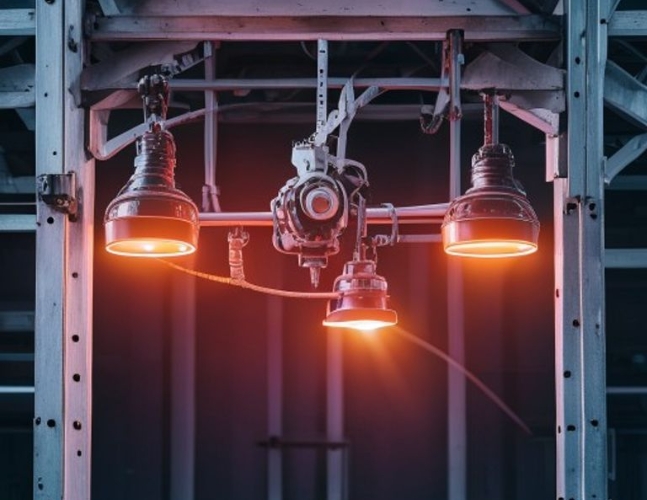
Optical Data Transmission provides a non-contact alternative. Hokuyo's DMH Series supports high-speed optical communication in applications where moving equipment requires reliable, non-contact data transfer without the maintenance associated with physical cables or slip rings.
Key advantages include:
- Reduced mechanical wear by eliminating moving communication cables.
- Greater design flexibility for long-travel crane applications.
- Reliable communication through line-of-sight optical transmission that is unaffected by electromagnetic interference (EMI).
For facilities looking to improve crane reliability while reducing maintenance requirements, Optical Data Transmission offers a practical solution for modern material handling systems.
Enhancing AGV and AMR Efficiency
Automated Guided Vehicles (AGVs) and Autonomous Mobile Robots (AMRs) depend on more than accurate navigation. As they move materials throughout a facility, they must also exchange operational data with conveyors, transfer stations, and other automated equipment to support efficient material flow.
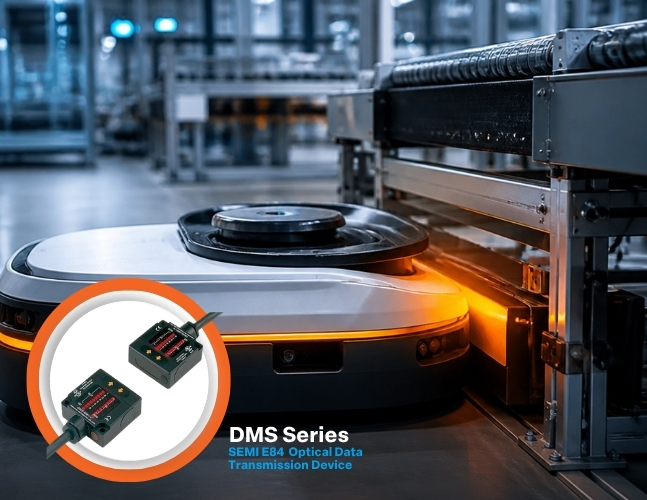
Traditional communication methods can introduce challenges when moving equipment relies on physical connectors that are subject to wear or require precise alignment. Hokuyo's DMS Series Optical Data Transmission devices provide a non-contact communication solution that enables high-speed data exchange between moving and stationary equipment using parallel I/O.
By eliminating physical communication contacts, Optical Data Transmission helps reduce maintenance requirements while supporting reliable material transfers and automated handoff processes across manufacturing, warehousing, and industrial automation applications.
Optical vs. Radio: Why Not Just Use Wi-Fi?
A common question is: Why use Optical Data Transmission instead of industrial wireless communication? The answer depends on the application. While industrial wireless technologies, including Wi-Fi, are well suited for many applications, Optical Data Transmission offers distinct advantages when reliable, line-of-sight communication between moving and stationary equipment is required.
Some of the key considerations include:
-
Immunity to Electromagnetic Interference (EMI): Industrial environments often contain motors, welders, and high-voltage equipment that can generate electromagnetic interference. Because Optical Data Transmission uses infrared light rather than radio frequency (RF) signals, it is not affected by EMI.
-
Low-Latency Communication: For applications where communication speed is critical, Hokuyo's DMH Series provides high-speed optical data transmission designed to support reliable, repeatable communication between moving and stationary equipment.
-
Contained Communication Path: Unlike RF communication, which can extend beyond the intended coverage area, Optical Data Transmission relies on a directed, line-of-sight beam between the transmitter and receiver. This controlled communication path can help support reliable data exchange in demanding industrial environments.
The Hokuyo Advantage: DMS and DMH Series
Hokuyo offers multiple Optical Data Transmission solutions designed to support a wide range of industrial communication requirements.
DMS Series
The DMS Series is designed for reliable parallel I/O communication between moving and stationary equipment. These compact devices are commonly used in applications requiring dependable, non-contact data transfer, including:
- Automated material handling systems
- Semiconductor manufacturing and SEMI E84-compliant communication
- Machine interlocks and equipment handshakes
- Industrial automation requiring reliable parallel I/O
DMH Series
The DMH Series is designed for applications that require higher-speed optical communication. It is well suited for rotating equipment, overhead cranes, and other industrial systems where reliable data transfer is needed without the maintenance associated with physical cables or slip rings.
Whether supporting material handling, crane communication, rotating machinery, or semiconductor automation, Hokuyo's Optical Data Transmission portfolio provides non-contact communication solutions designed for demanding industrial environments.
Future-Proofing Your Automation
As manufacturing, fabrication, and industrial automation continue to evolve, reliable communication becomes just as important as reliable sensing. Optical Data Transmission helps organizations reduce mechanical complexity while supporting dependable, non-contact communication across a wide range of automation applications.
Whether you're modernizing overhead crane communication, supporting AGV and AMR material handling, or implementing automated manufacturing systems, Hokuyo's Optical Data Transmission solutions are designed to help improve reliability, operational efficiency, and long-term performance.
Have questions about selecting the right Optical Data Transmission solution for your application? Contact Hokuyo's team to discuss your operational requirements and identify the configuration that best fits your industrial environment.