
 Factory Automation
 Logistics Automation
 Process Automation
 Crane Collision Avoidance
 LiDAR Sensors
 Safety Laser Scanners
 Optical Data Transmission
 Hot Metal Detectors
 Laser Distance Sensor
 Blog
Blog Whitepapers
 Case Studies
 Infographics
Choosing an industrial sensor is one of the most important decisions in designing an automated system. Sensors serve as the “eyes” of machinery, providing the data required for robots, AGVs, and overhead cranes to operate safely and efficiently within their environments. If a sensor is not properly matched to the application or operating conditions, the result can be reduced efficiency, unexpected downtime, or compromised safety performance.
This guide provides a practical framework for navigating the sensor selection process. By evaluating application requirements, environmental conditions, and key technical specifications, you can identify a sensing solution that delivers both high performance and long-term reliability.
Starting with the Application
The first step in selecting an industrial sensor is defining the primary objective of the application. Are you guiding an autonomous vehicle, protecting personnel around moving equipment, detecting objects within a defined area, or transmitting data across a facility? Each objective requires a different sensing approach.
For example, a 2D LiDAR scanner used for navigation has different requirements than a safety laser scanner designed for personnel protection. Navigation sensors prioritize accurate distance measurement and environmental mapping, while safety scanners are engineered to support protective functions within regulated industrial environments.
It is also important to consider how the sensor will be used within the system. Is it mounted in a fixed position, or integrated into a mobile platform such as an AGV or AMR? Mobile applications often require compact, lightweight sensors capable of maintaining stable performance in vibration-prone environments.
Knowing Your Sensor Types
Once you have defined your application goals, the next step is matching them to the appropriate sensing technology. Hokuyo organizes its solutions by application and functionality, helping simplify the selection process.
2D LiDAR for Navigation
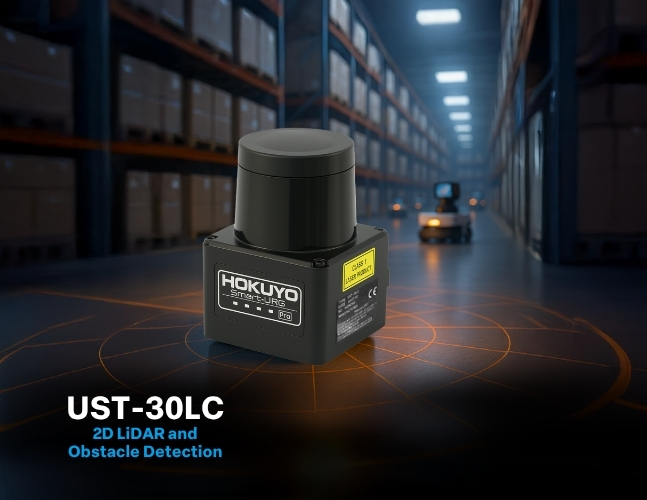
2D LiDAR is widely used in mobile robotics and automated navigation systems. Sensors such as the UST-30LC and URM-40LC-EWT emit laser pulses across a single scanning plane to generate real-time environmental data for navigation and obstacle detection.
These sensors are well-suited for AGV and AMR applications, providing a wide field of view for detecting obstacles and navigating complex industrial environments such as warehouses and manufacturing facilities.
3D LiDAR for Depth and Obstacle Detection
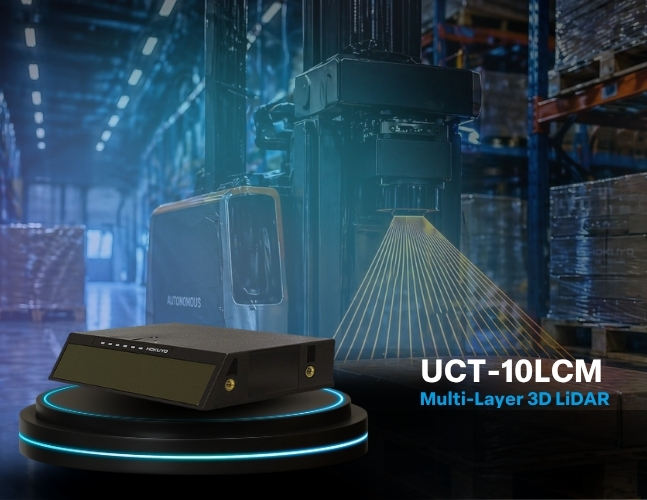
While 2D sensors are highly effective for navigation across a single scanning plane, some applications require additional spatial awareness. The UCT-10LCM 3D LiDAR sensor provides multi-layer detection with a 100° horizontal and 6° vertical field of view, enabling systems to detect obstacles and elevation changes that a traditional 2D scan may miss.
This added depth awareness is valuable for applications involving pallet detection, obstacle recognition, and mobile robotics operating in dynamic or less structured environments. By capturing data across multiple layers, 3D LiDAR supports more advanced navigation and positioning capabilities.
Safety Laser Scanners for Personnel Protection
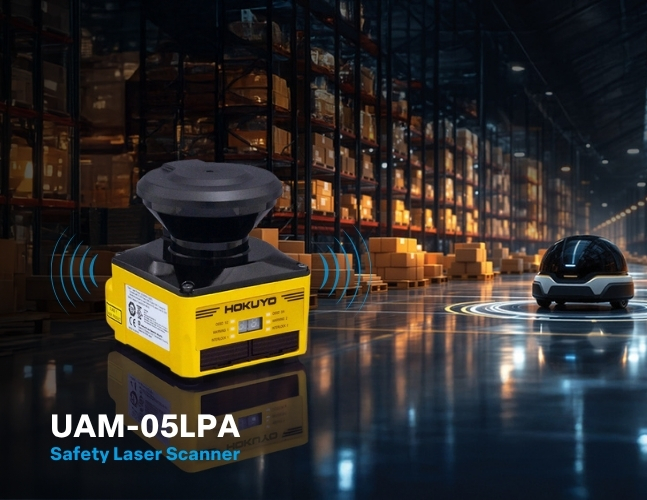
When personnel safety is the priority, dedicated safety sensing technology is essential. The UAM-05LP and UAM-05LPA safety laser scanner series are designed to support protective monitoring in industrial environments.
These scanners allow users to configure customizable protective and warning zones around equipment and automated systems. If a person enters a defined protective zone, the scanner can trigger a machine stop signal to support safe operation.
Safety laser scanners are foundational components in environments where humans and automation operate within shared workspaces.
Optical Data Transmission for Industrial Communication
In some industrial environments, physical cabling can introduce maintenance challenges and mechanical wear. Systems such as overhead cranes and automated storage and retrieval systems (AS/RS) often require continuous communication while in motion.
Hokuyo’s optical data transmission devices, including the BWF, CWF, and EWF series, use infrared light to enable contactless data communication across industrial systems. The BWF series supports long-distance communication of up to 200 m, helping eliminate the wear associated with festoon cables and slip rings.
By removing physical contact points, optical data transmission solutions help improve system reliability while reducing maintenance requirements.
Matching Coverage to Application Requirements
A sensor is only effective if it can accurately monitor the environment it is intended to support. To achieve reliable performance, the sensor’s detection range and field of view (FOV) must align with the physical requirements of the application.
Detection range is a critical consideration. A sensor used on a small indoor mobile robot may require only short-range coverage, while applications such as crane collision avoidance or large-scale outdoor automation may require significantly longer detection distances. If the range is too limited, the system may not have sufficient time to respond to obstacles. Conversely, excessive range without appropriate filtering can introduce unnecessary environmental data.
Field of view is equally important. Many Hokuyo LiDAR sensors provide a wide scanning angle, making them well-suited for AGV and AMR navigation. A broader field of view enables a single sensor to monitor a larger area around a vehicle, helping reduce blind spots and minimizing the number of sensors required for effective coverage.
Evaluating the Operating Environment
The operating environment is one of the most important factors in sensor selection. A sensor that performs well in a clean, climate-controlled setting may not deliver the same reliability in a dusty warehouse, vibration-heavy production area, or outdoor industrial environment.
Environmental conditions such as dust, debris, moisture, lighting variability, and vibration can all impact sensing performance. Selecting a sensor designed for the realities of the application helps ensure consistent operation, reliable detection, and long-term system stability.
Managing Dust, Rain, and Environmental Noise
Outdoor and industrial environments can introduce conditions such as dust, rain, mist, and airborne particles that interfere with sensor performance. In these situations, unwanted reflections may affect detection accuracy if the sensing system cannot properly distinguish environmental noise from actual objects.
To help address these challenges, select Hokuyo LiDAR sensors utilize multi-echo technology. This capability allows the sensor to process multiple reflected signals from a single laser pulse, improving its ability to distinguish relevant objects from environmental interference.
By filtering out unnecessary noise, multi-echo processing helps improve detection reliability in demanding industrial and outdoor environments.
Lighting, Temperature, and Environmental Protection
Environmental lighting conditions can impact sensor performance, particularly in applications exposed to direct sunlight or high-intensity industrial lighting. Selecting sensors designed to operate reliably under varying ambient light conditions is important for maintaining consistent detection performance.
Environmental protection ratings should also be considered. In demanding industrial or outdoor applications, IP-rated sensors help provide protection against dust and moisture exposure. For environments involving water, debris, or wash-down conditions, higher ingress protection ratings may be required to support long-term reliability.
Prioritizing Data Quality and Reliability
In industrial automation, data quality is directly tied to system reliability. Accurate, stable sensor data enables control systems to respond consistently and make informed operational decisions.
When sensor data is inconsistent or affected by environmental noise, additional processing may be required to filter and interpret the information. In high-speed automation environments, unnecessary processing delays can impact responsiveness and overall system performance.
By prioritizing sensing solutions that deliver precise measurement and stable output, operations can help reduce false detections, improve system efficiency, and minimize unnecessary downtime.
Simplifying Integration
A sensing solution is only effective if it integrates efficiently with the existing control architecture. Before selecting a device, it is important to evaluate the communication interfaces and protocols supported by the system.
Many modern industrial sensors utilize Ethernet-based communication for high-speed data transfer, while other applications may rely on serial interfaces such as RS-232 or RS-422 depending on system requirements. Hokuyo product specifications provide detailed interface information for each model to help simplify system integration.
Selecting a sensor that aligns with the existing automation infrastructure can help reduce commissioning complexity, minimize additional hardware requirements, and streamline deployment.
Designing for Human-Machine Collaboration
Industry 5.0 emphasizes closer collaboration between humans and automation systems. To support this environment effectively, sensing technologies must enable safe interaction without unnecessarily interrupting production.
Advanced safety laser scanners support configurable protection strategies through flexible warning and protective zones. These zones can be adjusted based on machine movement, operational status, or application requirements—allowing systems to respond dynamically to nearby personnel.
This layered approach helps maintain both safety and productivity by supporting controlled machine response rather than relying solely on full system stops.
Planning for Scalability
As automation requirements evolve, sensing needs often expand as well. A facility that begins with a single AGV or basic navigation system today may later require more advanced sensing, broader coverage, or additional automation infrastructure.
Selecting a sensor provider with a broad portfolio can help simplify long-term scalability. Expanding from 2D navigation sensing to multi-layer 3D LiDAR or integrating optical data transmission solutions becomes more manageable when systems are designed to operate within a consistent technology ecosystem.
A unified sensing approach can also help streamline maintenance, integration, and operator training as automation deployments grow over time.
Conclusion
Choosing the right industrial sensor is not simply about selecting the longest range or the lowest cost. It is about identifying the sensing solution that best aligns with the application, operating environment, and long-term automation goals.
Whether the requirement involves compact 3D sensing for mobile robotics, reliable navigation for AGVs, safety monitoring for collaborative workspaces, or optical data transmission for moving systems, the right sensing foundation plays a critical role in operational performance.
At Hokuyo USA, we combine technical expertise with a broad portfolio of industrial sensing solutions designed to support navigation, safety, detection, and communication across modern automation environments.
Have questions about the right sensing solution for your application? Contact our team to discuss your project:
https://www.hokuyo-usa.com/contact-us