
 Factory Automation
 Logistics Automation
 Process Automation
 Crane Collision Avoidance
 LiDAR Sensors
 Safety Laser Scanners
 Optical Data Transmission
 Hot Metal Detectors
 Laser Distance Sensor
 Blog
Blog Whitepapers
 Case Studies
 Infographics
For decades, the goal of industrial automation was simple: remove the human from the process to increase speed and reduce errors. This was the hallmark of Industry 4.0—characterized by “dark factories” and isolated robotic cells. However, the industry is now shifting toward a new paradigm.
Industry 5.0 represents a move toward human-centric manufacturing. Instead of machines replacing people, this new era focuses on machines assisting people. It is a collaborative approach that pairs the precision of robotics with the critical thinking and creativity of human workers.
To make this collaboration possible, machines need more than just programming—they need perception. They must understand the three-dimensional world in real time. This is where LiDAR technology becomes the essential bridge between the mechanical and the human.
Redefining the Factory Floor with Human-Centric Automation
Industry 5.0 acknowledges that while robots excel at repetitive, high-speed tasks, humans remain the best decision-makers for complex problem-solving. This shift requires a fundamental change in how automated systems are designed. We are moving away from rigid setups where humans must stay behind light curtains or physical barriers.
In a human-centric environment, the machine must adapt to the person—not the other way around. If a worker approaches a robotic arm, the system should slow down or adjust its path. If an Automated Guided Vehicle (AGV) encounters a person in a narrow aisle, it should yield or navigate around them without disrupting the entire production flow.
Enabling this level of flexibility requires sophisticated AGV sensors that provide continuous environmental feedback. By utilizing LiDAR, machines gain the spatial awareness needed to operate safely and efficiently alongside their human counterparts.
Understanding LiDAR as the "Eyes" of the Machine
LiDAR, which stands for Light Detection and Ranging, works by emitting laser pulses and measuring the time it takes for them to reflect off objects. This data is used to calculate distances and create high-resolution maps of the surrounding environment.
In industrial settings, LiDAR systems are typically categorized into two types:
- 2D LiDAR scanners: These devices scan a single plane, creating a two-dimensional “slice” of the environment. They are ideal for area monitoring, safety zone definition, and basic navigation.
- 3D LiDAR sensors: These sensors capture volumetric data, enabling machines to detect height, depth, and width. This is critical for identifying obstacles that a 2D scanner might miss—such as forklift tines, uneven loads, or overhead obstructions.
By integrating these sensors, equipment gains the ability to perceive depth, position, and movement in real time. This transforms machines from reactive tools into intelligent systems capable of navigating the complexities of a shared workspace.
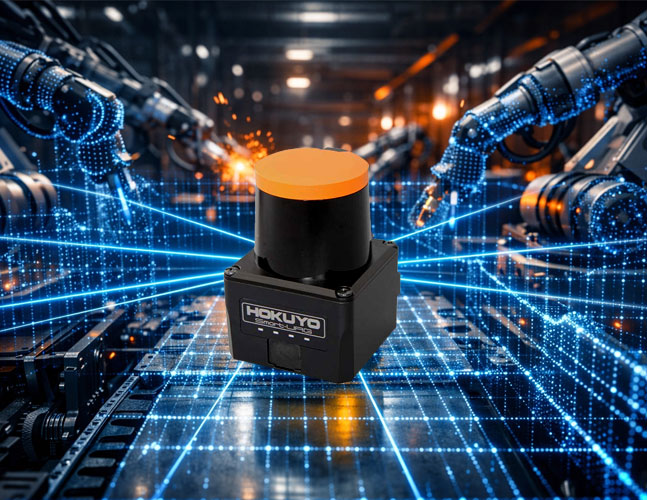
Enhancing Safety with the Safety Laser Scanner
Safety is the first—and most critical—requirement for effective human-machine collaboration. A shared workspace cannot function if the risk of collision remains high. This is why laser safety scanners have become a foundational component of modern production environments.
The UAM-05LP exemplifies how advanced sensing supports Industry 5.0 applications. As one of the most compact safety laser scanners available, it integrates easily into space-constrained systems such as AGVs and mobile robots—without compromising performance.
The UAM-05LP enables precise configuration of safety zones. If a person enters a warning zone, the system can trigger an alert or reduce machine speed. If the protective zone is breached, the scanner initiates an immediate safety stop.
This tiered safety approach allows humans and machines to operate within the same environment—balancing protection with productivity while minimizing unnecessary downtime.
Moving Toward Flexible Navigation with 3D LiDAR
While traditional LiDAR scanners operate on a single scanning plane, the industry is advancing toward multi-layer and 3D sensing for greater environmental awareness. Sensors like the UCT-10LCM represent the next step in enabling more adaptive and intelligent automation.
Designed with a multi-layer scanning structure, the UCT-10LCM captures spatial data across both horizontal and vertical fields of view. This allows systems such as AGVs and AMRs to detect not only what is directly ahead, but also changes in elevation—such as pallet pockets, drop-offs, or low-hanging obstacles.
This added dimension of perception is critical for flexible automation. In real-world environments, conditions are rarely perfect. Loads may shift, materials may be uneven, and unexpected obstacles can appear. While a standard 2D LiDAR scanner may miss these variations, a 3D LiDAR sensor provides the depth and context needed for more accurate, real-time decision-making.
The result is safer navigation, improved adaptability, and more reliable performance in dynamic industrial environments.
Why Real-Time Spatial Awareness Changes Everything
In Industry 5.0, data must be processed in milliseconds. If a machine takes even a fraction of a second too long to recognize human presence, the safety margin is reduced. Real-time spatial awareness means the system is continuously interpreting its surroundings and responding accordingly.
This level of awareness enables three key capabilities:
- Dynamic Path Planning: Instead of following fixed paths such as magnetic tape, AGV LiDAR systems allow vehicles to calculate the most efficient route through changing environments.
- Adaptive Velocity Control: Machines can maintain higher speeds in clear areas and automatically slow down when sensors detect increased human activity or obstacles.
- Predictive Avoidance: By analyzing movement patterns, advanced systems can anticipate the trajectory of a person or object—allowing the machine to adjust its path before a potential conflict occurs.
Together, these capabilities ensure that automation enhances the human work environment—supporting safety, efficiency, and seamless collaboration rather than introducing risk.
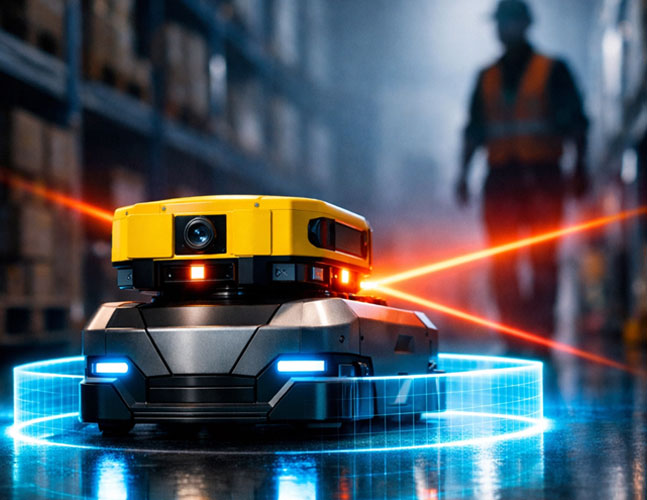
Scaling Applications: From Warehouses to Outdoor Environments
The need for LiDAR-driven awareness extends beyond the indoor factory floor. As automation expands into ports, construction sites, and agriculture, the demands placed on outdoor LiDAR sensors become significantly more complex.
Outdoor environments introduce challenges such as rain, dust, and fluctuating lighting conditions. Hokuyo sensors are designed to filter out this environmental noise, ensuring reliable detection of solid objects—even in less controlled settings. Whether supporting crane collision avoidance or
port automation, the objective remains the same: protecting people while maintaining productivity.
In large-scale logistics operations, for example, LiDAR enables heavy equipment to operate safely alongside human workers, including truck drivers and inspectors. These sensors provide continuous, real-time awareness—helping systems respond accurately to their surroundings and supporting safer, more efficient operations.
Designing Systems That Adapt to Humans
The ultimate goal of Industry 5.0 is to create systems that are intuitive. A human operator should not need to understand a robot’s code to work alongside it—the system should recognize and respond to human presence through its sensing capabilities.
This philosophy guides how sensing technologies are developed. The focus is on solutions that are easy to integrate while delivering highly accurate, real-time data. With reliable input from a 3D LiDAR sensor, software systems can make more informed and responsive decisions.
By reducing risk and improving a system’s ability to adapt to dynamic conditions, automation becomes a tool that supports human decision-making. Workers can focus on higher-value tasks with confidence, knowing the systems around them are aware, responsive, and designed to operate safely within shared environments.
The Future of Sensor-Driven Operations
The transition to Industry 5.0 is already underway. We see it in the growing adoption of collaborative robots (cobots) and more advanced Autonomous Mobile Robots (AMRs). Across these deployments, one constant remains: the need for high-performance sensing.
Looking ahead, the integration of LiDAR with AI and machine learning will further strengthen the connection between humans and machines. Sensors will evolve beyond simple detection—enabling systems to interpret movement, context, and intent to support more seamless collaboration.
At Hokuyo USA, we are focused on providing the sensing foundation for this next phase of automation. Our portfolio of 2D and 3D LiDAR solutions is designed to meet the demands of modern industrial environments—delivering the accuracy, reliability, and real-time performance required for safe and efficient operation.
Let’s Build the Future Together
Bridging the gap between humans and machines is more than a technical challenge—it’s an opportunity to create safer, more efficient, and more productive workplaces. By implementing the right LiDAR technology, you can ensure your facility is prepared for the demands of Industry 5.0.
Are you ready to enhance your system’s spatial awareness? Whether you need a reliable safety laser scanner for a new robotic cell or advanced AGV sensors for a fleet of mobile robots, our team is here to help.
Connect with our experts to identify the right sensing solution for your application—and take the next step toward smarter, more adaptable automation.