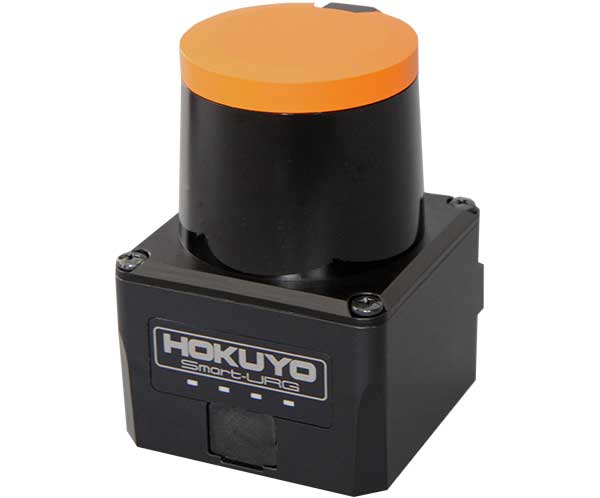
LiDAR sensors for presence detection, mapping, and area monitoring.

Compact, reliable, and built for industrial automation.

Hokuyo’s LiDAR obstacle detection sensors capture precise distance data for presence detection, area monitoring, and spatial recognition. Engineered for accuracy and reliability, our sensors provide high-resolution scanning with up to 270° coverage in a compact, lightweight design.

Whether protecting machinery, supporting AMR navigation and localization applications, guiding autonomous vehicles, or mapping production lines, Hokuyo LiDAR sensors deliver dependable performance that keeps operations efficient and safe. Prevent unnecessary downtime, reduce costly damage, and improve spatial awareness with industry-proven technology.

Browse our full range of 2D and 3D LiDAR sensors to find the right solution for your application, or contact our team for expert guidance on integration and selection.


 

LiDAR Sensors UST 05LX

UST-05LX

2D LiDAR Sensor
View Product
LiDAR Sensors UST 05LA

UST-05LA

2D LiDAR Sensor
View Product
LiDAR Sensors UST 10LX

UST-10LX

2D LiDAR Sensor
View Product
LiDAR Sensors UST 15LX

UST-15LX

2D LiDAR Sensor
View Product
LiDAR Sensors UST 20LX

UST-20LX

2D LiDAR Sensor
View Product
LiDAR Sensors UST 30LX

UST-30LX

2D LiDAR Sensor
View Product
LiDAR Sensors UST 30LC

UST-30LC

2D LiDAR and Obstacle Detection
View Product
LiDAR Sensors UTM 30LX

UTM-30LX

2D LiDAR Sensor
View Product
LiDAR Sensors UTM 30LX EW

UTM-30LX-EW

2D LiDAR Sensor
View Product
LiDAR Sensors URM 40LC EWT

URM-40LC-EWT

Outdoor-rated 2D LiDAR Sensor
View Product
LiDAR Sensors UXM 30LX EW

UXM-30LX-EW

Outdoor-rated 2D LiDAR Sensor
View Product
LiDAR Sensors UXM 30LXH EWA

UXM-30LXH-EWA

Outdoor-rated 2D LiDAR Sensor
View Product

Compare Industrial LiDAR Sensor Types

Selecting a LiDAR sensor starts with the information your equipment needs to collect. Hokuyo provides 2D, 3D, and multi-layer LiDAR sensing options for robotics, manufacturing, material handling, and industrial automation.

2D LiDAR Sensors

Scan across a defined plane to collect distance measurements for localization, navigation, obstacle detection, and area monitoring.

Common applications:

  • AMR and AGV navigation
  • Robot localization
  • Industrial obstacle detection
  • Area monitoring

3D LiDAR Sensors

Collect spatial information across multiple dimensions when objects, heights, or changing environments require more than a single scan plane.

Common applications:

  • 3D mapping
  • Spatial recognition
  • Industrial vehicle perception
  • Object profiling

Multi-Layer LiDAR Sensors

Capture measurements across multiple scan layers for applications where additional vertical awareness can improve obstacle detection.

Common applications:

  • Mobile robot obstacle awareness
  • Detection at different heights
  • Material handling equipment
  • Complex industrial environments

Compare Hokuyo LiDAR Sensor Families

The following product families are useful starting points. Compare current model specifications before selecting a sensor for your application.

Product family Sensor type Application fit Learn more
UST Series Compact 2D LiDAR Indoor robotics, AMR navigation, localization and obstacle detection View UST-10LX
UTM Series 2D LiDAR Mapping, localization and longer-range 2D scanning View UTM-30LX
YVT / YHT Series 3D LiDAR Spatial recognition, mapping, vehicle perception and additional height awareness Explore 3D models
UCT Series Multi-layer LiDAR Multi-layer obstacle detection and industrial mobile robotics Explore multi-layer models

How to Select a LiDAR Sensor for Your Application

The correct sensor depends on more than its maximum measurement range. Engineers should evaluate the following requirements.

  1. Detection range: Determine the minimum and maximum distances at which objects must be measured or detected.
  2. Field of view: Identify the horizontal and vertical coverage required for the installation.
  3. 2D versus 3D scanning: Determine whether a single scan plane is sufficient or whether the application requires height and depth information.
  4. Scanning performance: Evaluate angular resolution, scan rate, measurement accuracy, and processing needs.
  5. Operating environment: Consider dust, temperature, vibration, rain, sunlight, contamination and other exposure conditions.
  6. Controller integration: Confirm the supported interface, available data output, software compatibility and communication needs.
  7. Mounting and coverage: Review the installation location, potential blind spots, equipment geometry and required detection plane.

For a detailed comparison with other sensing technologies, read our industrial sensor selection guide .

Frequently Asked Questions About Industrial LiDAR Sensors

Which LiDAR sensor is best for an AMR?

The right LiDAR sensor depends on the robot's navigation requirements, operating environment, detection range, field of view and interface. Compact 2D LiDAR sensors are a common starting point for indoor AMRs. Applications requiring additional spatial awareness may benefit from 3D or multi-layer sensing.

What is the difference between 2D and 3D LiDAR sensors?

A 2D LiDAR sensor collects distance information across a scanning plane. A 3D LiDAR sensor provides additional spatial information that can help identify objects at different heights or within more complex environments.

Can industrial LiDAR sensors be used outdoors?

Certain Hokuyo LiDAR models are designed for outdoor or demanding industrial environments. Review each model's environmental rating, operating limits, and detection performance under the expected conditions.

Can LiDAR sensors detect obstacles around industrial equipment?

Yes. LiDAR sensors can provide distance and object-detection data for machinery, mobile robots and automated equipment. Detection performance depends on object characteristics, scan coverage, sensor placement and environmental conditions.

Is a navigation LiDAR sensor the same as a safety laser scanner?

No. Navigation LiDAR commonly supports localization, mapping and obstacle awareness. A safety laser scanner is designed for defined safety-rated protective functions when correctly selected and integrated into a validated safety system.

Explore Hokuyo safety laser scanners .

Need Help Choosing a LiDAR Sensor?

Contact Hokuyo-USA to discuss your detection range, application, environment, installation and integration requirements.

Talk to a Hokuyo Specialist