How Do I Choose Between a LiDAR Sensor, Laser Scanner, Photoelectric Sensor, and Laser Distance Sensor?
Choose the technology by defining what the machine must detect or measure, how much information the controller needs, the required range, the operating environment, and whether the function involves personnel safety.
Short answer: Use a photoelectric sensor for simple point-based presence detection. Use a laser distance sensor when the system needs a precise distance to one target. Use a 2D or 3D LiDAR sensor when a robot or machine must understand an area, profile, or surrounding environment. Use a safety laser scanner when the application requires properly engineered, safety-rated personnel protection.
The four sensing technologies at a glance
Area and spatial awareness
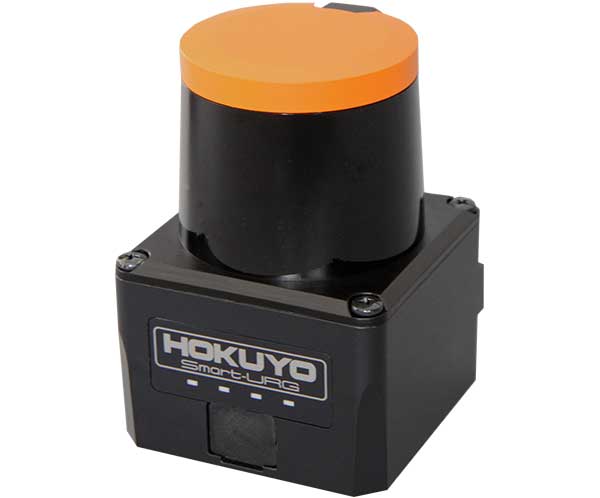
LiDAR sensor
LiDAR measures reflected laser light across many points to create a 2D scan or 3D representation. It is commonly used for navigation, localization, mapping, obstacle detection, object profiling, and area monitoring.
Best when: an AMR, AGV, robot, or automated system needs more than a single yes-or-no detection point.
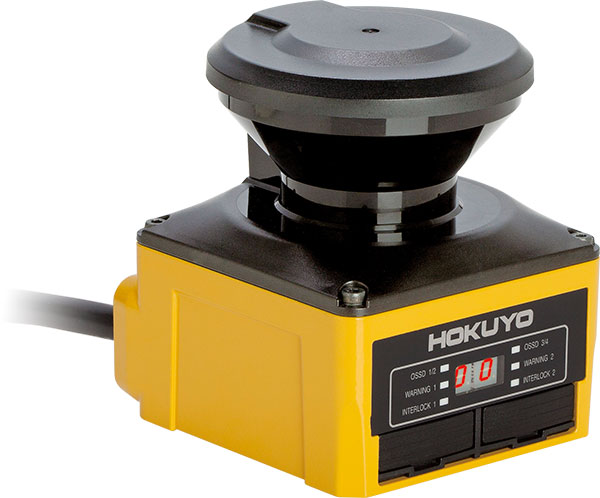
A safety laser scanner monitors configurable protective and warning fields. When correctly selected and integrated into a safety-related control system, it can support personnel protection around mobile robots, machinery, work cells, and access points.
Best when: detecting a person or intrusion must initiate a safety response such as slowing or stopping equipment.
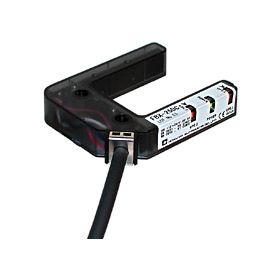
A photoelectric sensor uses emitted and received light to determine whether an object is present. Through-beam, retroreflective, and diffuse-reflective arrangements serve different target and installation conditions.
Best when: the control system only needs to know whether a part, package, pallet, or material has reached one specific point.
Single-point measurement
Laser distance sensor
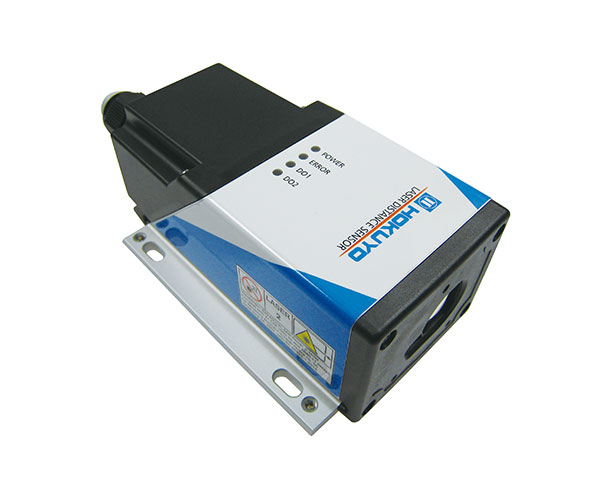
A laser distance sensor measures the distance to a target along one measurement path. It is useful for positioning, level measurement, dimensional control, crane travel, stockyard systems, and long-range industrial measurement.
Best when: the controller needs a precise numeric distance to a defined target rather than a map of the surrounding area.
Height, depth, width, ramps, loads, or irregular objects matter
Safety laser scanner
Safety outputs plus configurable protective and warning fields
Mobile robot safety, machine guarding, work-cell monitoring, access protection
The application requires a safety-rated protective function
Start with the automation question you need answered
“Is the object here?” Start with a photoelectric sensor.
“Exactly how far away is it?” Start with a laser distance sensor.
“What objects or open paths exist across this area?” Start with 2D LiDAR.
“What is the shape, height, or position of objects in space?” Start with 3D LiDAR.
“Has a person entered a hazardous area?” Evaluate a safety laser scanner as part of the complete machine-safety system.
Terminology matters: “Laser scanner” can describe a general LiDAR scanning device or a safety-rated laser scanner. Those are not automatically interchangeable. Confirm whether the required function is navigation, measurement, equipment protection, or certified personnel protection before choosing a model.
Selection factors that can change the answer
Target and task
Consider object size, shape, color, reflectivity, surface finish, speed, orientation, and whether the target can be transparent, dark, hot, dusty, or irregular.
Range and field of view
Define the minimum and maximum distance, required coverage, blind zones, mounting height, angular resolution, and any areas hidden by the machine or load.
Operating environment
Review dust, rain, mist, ambient light, temperature, vibration, electrical noise, lens contamination, washdown, and indoor or outdoor exposure.
Controls and data
Confirm whether the PLC or robot needs discrete I/O, analog output, Ethernet data, a point cloud, encoder input, ROS support, EtherCAT, or another interface.
Frequently asked questions
Is a LiDAR sensor the same as a laser scanner?
The terms sometimes overlap because many LiDAR devices scan laser measurements across an area. However, “laser scanner” may also refer specifically to a safety laser scanner. The product's intended function, outputs, certifications, and integration requirements determine whether it is suitable for navigation, measurement, or personnel protection.
When is a photoelectric sensor better than LiDAR?
A photoelectric sensor is often the simpler choice when the system only needs reliable detection at one known point, such as confirming that a box reached a conveyor station. LiDAR becomes more useful when the system needs distances across an area, object position, navigation, mapping, or changing detection zones.
What is the difference between LiDAR and a laser distance sensor?
A laser distance sensor typically measures one defined target along one path. LiDAR gathers many distance measurements across a field of view to describe a plane or three-dimensional space.
Can a standard LiDAR sensor be used for machine safety?
A standard LiDAR sensor should not be assumed to provide a safety-rated personnel-protection function. Applications involving hazardous motion require an appropriate risk assessment, safety-rated components, correct integration, and validation under the applicable standards.
Still deciding which sensor type fits the application?
Share the detection task, required range, target, environment, machine or robot type, output needs, and safety requirements. Hokuyo-USA can help narrow the technology and product family to evaluate.

 Factory Automation
 Logistics Automation
 Process Automation
 Crane Collision Avoidance
 LiDAR Sensors
 Safety Laser Scanners
 Optical Data Transmission
 Hot Metal Detectors
 Laser Distance Sensor
 Blog
Blog Whitepapers
 Case Studies
 Infographics