
 Factory Automation
 Logistics Automation
 Process Automation
 Crane Collision Avoidance
 LiDAR Sensors
 Safety Laser Scanners
 Optical Data Transmission
 Hot Metal Detectors
 Laser Distance Sensor
 Blog
Blog Whitepapers
 Case Studies
 Infographics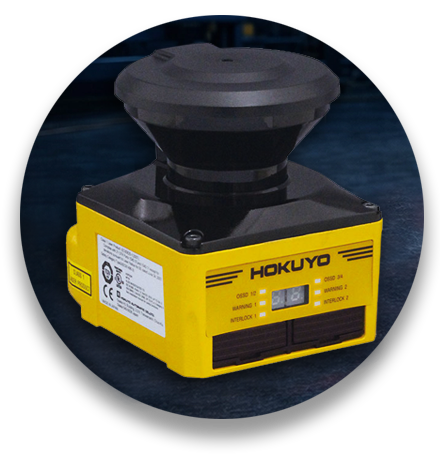
Safety devices are machine controls that detect when a person enters a hazardous area and trigger a safe stop or controlled slowdown. In manufacturing and metal fabrication, that means protecting people around press brakes, robotic welders, CNC machines, and conveyors—without turning the entire line into a stop-and-go process.
Light curtains are safety devices, but they only protect a straight line of entry. Safety laser scanners (such as Hokuyo’s UAM series for area protection) safeguard a defined zone, which is why they often make more sense when layouts change, access points multiply, or floor space is limited.
Let’s take a closer look at why safety laser scanners are often the more efficient and flexible solution for guarding modern fabrication lines compared to light curtains.
Understanding the "Invisible Wall": How Light Curtains Work
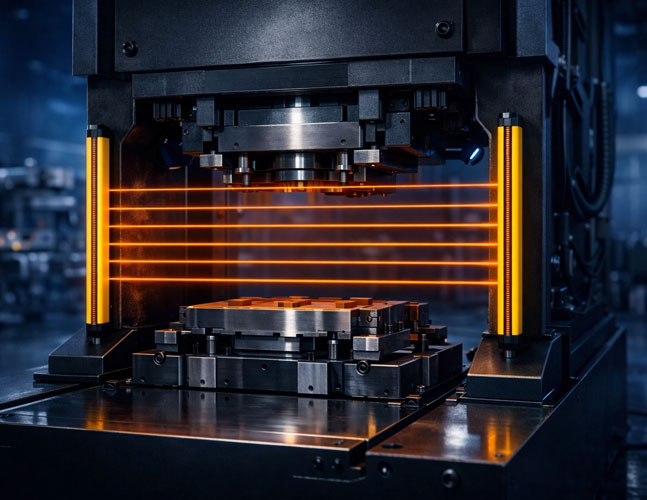
A light curtain is an optoelectronic device that creates a multi-beam “invisible wall” of infrared light. It consists of two main components: a transmitter and a receiver. The transmitter emits synchronized, parallel light beams to the receiver, forming a protective field.
When an object—such as an operator’s hand or an entire person—interrupts one or more of these beams, the receiver detects the signal loss and immediately sends a stop signal to the machine’s control system. This process occurs in milliseconds, ensuring the hazard is addressed before the person can reach the point of operation.
Light curtains are commonly used for point-of-operation protection. When there is a single, defined entry point to a machine—such as the opening of a hydraulic press—they provide a slim, high-resolution safety barrier without requiring a physical gate. This allows operators to load and unload parts efficiently without repeatedly opening and closing doors throughout the shift.
Using Safety Laser Scanners: The Area Protectors
While light curtains create a vertical or horizontal “wall,” safety laser scanners—often referred to as safety sensors in fabrication—create a two-dimensional “safety zone” across a floor or defined area. These sensors use Time-of-Flight (ToF) technology, emitting a laser pulse and measuring the time it takes for that pulse to reflect off an object and return to the sensor.
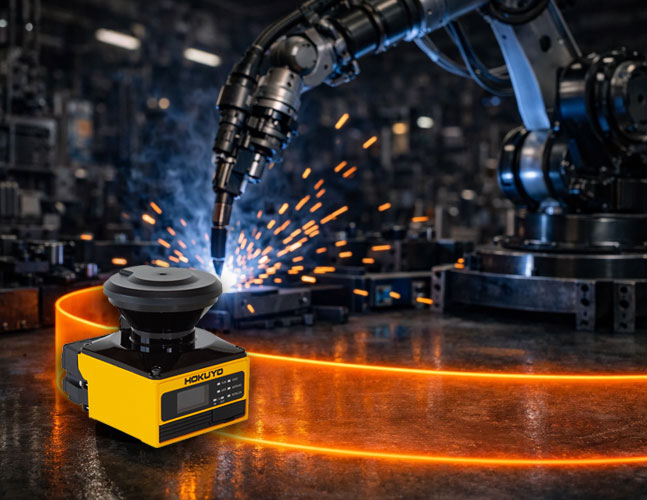
By rotating the laser beam, the sensor can monitor a wide area—often up to 270 degrees. Specific “warning zones” and “protection zones” can be programmed into the system. For example, if a person enters the warning zone, the machine may slow down or trigger an audible alert. If they enter the protection zone, the machine stops immediately.
These sensors are well suited for real-world applications where the hazard is not limited to a single point of entry. In a robotic welding cell, for instance, where risk exists across the entire work envelope, a safety laser scanner provides flexible, wide-area coverage that a single set of light curtains cannot.
Comparing Resolution and Precision
One of the key distinctions between these two technologies is resolution—the smallest object they can reliably detect.
Light curtains offer exceptionally high resolution, typically ranging from 14 mm (finger detection) to 30 mm (hand detection). This level of precision allows them to be installed closer to the hazard. Because the device can detect even small intrusions, the required “safety distance,” as defined by OSHA or ISO standards, is reduced.
Safety laser scanners, while highly advanced, generally have lower resolution for safety-critical detection compared to the fine beam arrays of a light curtain. They are designed to detect larger objects, such as a human leg or torso, and therefore typically require a larger safety buffer zone.
If your fabrication line has limited space and operators need to work in close proximity to the machine, the higher resolution of a light curtain is often the more suitable solution.
Navigating the Challenges of the Fabrication Environment
The environment of a fabrication shop is rarely “clean.” Welding sparks, grinding dust, and reflective metal surfaces can all impact sensor performance.
Dealing with Dust and Smoke
Light curtains can be sensitive to heavy airborne particulates. In environments with significant smoke from thermal cutting or high levels of dust, infrared beams may be disrupted, leading to “nuisance trips,” where the machine stops unexpectedly. While modern light curtains feature improved filtering, they still require a relatively clear line of sight.
Managing Reflective Surfaces
Fabrication often involves working with reflective materials such as stainless steel or aluminum. Infrared beams can bounce off these surfaces and return to the receiver—even when an object is present in the detection path. This phenomenon, known as “optical short-circuiting,” requires high-quality sensors and proper installation techniques to mitigate. Additional technical guidance can typically be found in product specifications.
Sparks and Weld Flash
In robotic welding environments, intense light and sparks can interfere with some optical sensors. Safety laser scanners are often more robust in these conditions because they can be mounted at floor level—away from the direct exposure of the weld arc—while still monitoring the full perimeter of the cell.
Recognizing Where Light Curtains Hit Their Limits
Light curtains are well-suited for point-of-operation access. They create an infrared beam grid across a single opening, protecting only what passes through that defined entry point.
However, their limitations become apparent when the risk area extends beyond a simple rectangular opening. Multiple access points, angled infeed and outfeed paths, and irregular perimeters often require stacking multiple curtain pairs, adding mounting posts, and continuously managing alignment.
Light curtains also depend on a clean, uninterrupted line of sight between the transmitter and receiver. In fabrication environments, where guarding, fixtures, carts, and frequent layout changes are common, this can lead to unintended beam interruptions—often perceived as inconsistent or unexplained machine stops on the floor.
Choosing Safety Laser Scanners as the Default for Flexible Cells
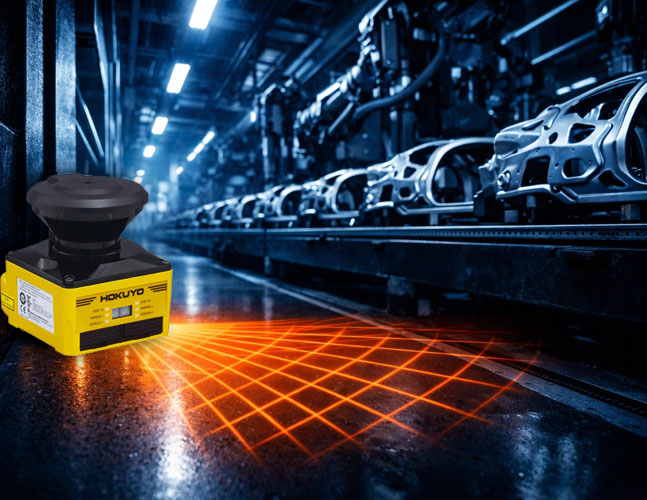
Safety laser scanners are area-protection devices that monitor a two-dimensional zone using Time-of-Flight (ToF) technology. This means they measure distance based on how long it takes for emitted laser light to return, enabling perimeter protection without requiring a physical beam barrier across each access point.
For fabrication environments that demand flexibility, safety laser scanners are often the preferred solution when requirements include:
- Space efficiency at the perimeter: A single scanner can be mounted at the edge of a cell to cover a wide area, reducing the need for additional frames, posts, or extended curtain runs.
- Support for irregular layouts: Curved, angled, and wraparound protection zones can be programmed to align with the actual hazard boundary.
- Multi-zone functionality: Configurable warning and protection zones enable controlled slowdowns before a full stop, helping maintain workflow continuity.
- Adaptability during changeovers: Selectable field sets allow protection zones to adjust based on machine state, part size, or tooling configuration.
- Coverage for moving automation: Well-suited for AGVs, AMRs, and automated forklifts operating in shared spaces where fixed beam barriers are impractical.
Safety laser scanners provide protection that adapts to the process—rather than forcing the process to conform to a fixed point of entry.
The Hybrid Approach: Combining Technologies
In many advanced fabrication environments, selecting a single safeguarding method is not necessary. A hybrid approach often delivers the most effective results.
For example, a safety laser scanner can be used to monitor the floor area surrounding a large CNC machining center, ensuring no personnel are present within the designated hazard zone during machine startup or operation. At the point of interaction, light curtains can be implemented at the load and unload station, allowing operators to safely access the workspace without requiring a full system shutdown.
This layered safeguarding strategy maintains protection across multiple zones—from the broader perimeter of the cell to precise point-of-operation access—ensuring both safety and operational efficiency.
Evaluating the Long-Term Impact on Cycle Time
When automation slows down, the root cause is often tied to suboptimal safety integration. An overly sensitive light curtain may result in frequent, unnecessary stops, while an oversized safety zone can halt operations whenever personnel pass through nearby areas.
Selecting the appropriate safeguarding solution requires a clear understanding of your workflow and operating conditions. Consider the following:
- Operator position: Where does the operator typically stand during operation?
- Frequency of access: How often is entry into the hazardous area required?
- Environmental conditions: What factors—such as dust, ambient light, or debris—may impact sensor performance?
- Available space: How much room exists to implement an effective safety buffer?
By evaluating these variables, you can implement a safety solution that not only meets compliance requirements but also supports cycle time optimization by minimizing unnecessary downtime.
Finding the Right Fit for Your Facility
Every fabrication line is unique. Whether the process involves sheet metal forming, robotic welding, or complex assembly, safety requirements will vary based on equipment, layout, and operator workflow.
At Hokuyo USA, we specialize in sensing technologies that enable safe, efficient productivity. We provide advanced LiDAR-based safety solutions and help navigate technical specifications to identify the right fit for each application.
If there is uncertainty around the optimal approach, our team can evaluate your layout and operating conditions to recommend a solution that enhances both safety and system performance.
Have questions about safety integration? Contact our experts today and let’s talk about your project.
Want the high-level overview on why safety lasers scanners are replacing light curtains? Start here…