
 Factory Automation
 Logistics Automation
 Process Automation
 Crane Collision Avoidance
 LiDAR Sensors
 Safety Laser Scanners
 Optical Data Transmission
 Hot Metal Detectors
 Laser Distance Sensor
 Blog
Blog Whitepapers
 Case Studies
 Infographics
Automated Guided Vehicles (AGVs), Autonomous Mobile Robots (AMRs), and industrial carts are the backbone of modern factories, warehouses, and distribution centers. But in busy, fast-moving environments - with pallets, racks, personnel, and machinery - a single misstep can lead to a costly collision or safety incident. That's why safety laser scanners have become a must-have technology.
By continuously scanning surroundings and defining customizable safety zones, laser scanners turn mobile platforms into aware, reactive systems. They extend the vision of robots, detect hazards long before impact, and stop or slow motion proactively. In this post, we’ll dive into how to deploy safety laser scanners on AGVs, AMRs, and carts. From planning and integration to real-world operation so you can boost safety, uptime, and operational confidence across your facility.
Why Mobile Platforms Need Safety Laser Scanners
Automated mobile platforms - AGVs, AMRs, industrial carts - are designed to carry heavy loads, move repeatedly along fixed or variable paths, and keep production logistics flowing. Yet, this constant movement occurs in highly dynamic spaces: humans walk around, forklifts pass by, pallets slide off racks, and debris drops on the floor.
Traditional safety measures like bumpers, safety mats, warning lights, even spotters are often reactive or limited in scope. Bumpers only detect after contact; mats require physical pressure; lights depend on visibility and awareness. In contrast, a safety laser scanner continuously monitors a wide area around the vehicle, detects obstacles before contact, and triggers timely slowdowns or stops.
Research shows that equipped with safety scanners, AGVs and AMRs dramatically reduce collision incidents in warehouses and production floors. For any business leveraging a fleet of mobile units - whether for parts delivery, material transfer, or internal logistics - scanner-based safety is no longer optional. It’s essential.
Unique insight
In facilities where mobile robots share space with humans and manual forklifts, the biggest risk isn't speed - it s unpredictability. Laser scanners give robots the perception they need to adapt, which removes the "safe assumption" from the equation.
What is a Safety Laser Scanner and How It Works
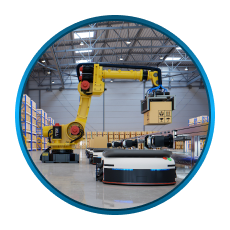
Unlike cameras or photocells, laser scanners don't rely on ambient light or reflectivity. They “see” based on geometry and distance. This allows them to operate reliably in low-light, dusty, or cluttered environments.
Key features:
- Wide scanning angle (often 270°–300°) for broad coverage.
- Configurable safety zones. e.g., a warning zone that triggers slowdown, and a protective zone that triggers a full stop.
- Adjustable detection range, scan frequency, and angular resolution depending on use case.
When an object enters a predefined zone, the scanner communicates directly with the vehicle's safety PLC or controller &- cutting power, halting motion, or rerouting the robot. This process happens in milliseconds, ensuring reactive but smooth automation.
Choosing the Right Scanner for Your Mobile Fleet
Selecting the right safety laser scanner comes down to aligning technical specs with your operation's demands. Key parameters to evaluate:
| Parameter | Why It Matters |
|---|---|
| Range | Determines how early the vehicle can detect obstacles — essential in high-speed AGVs or long-haul carts |
| Field of View (FOV) | A wide scan angle (≈ 270°–300°) covers more of the surroundings, minimizing “blind spots” |
| Scan Frequency / Response Time | Faster scan → quicker detection and reaction, critical for dynamic environments |
| Angular Resolution | Higher resolution improves detection of small or narrow obstacles (e.g., pallet legs, debris) |
| Size & Mounting Compatibility | Must fit the chassis of AGVs/AMRs/carts without interfering with payload or operation |
| Environmental Rating | Dust, water, and vibration resistance are critical for industrial settings |
For example, a warehouse AGV tasked with heavy pallet transport will benefit from a scanner with long range and wide FOV, while a small AMR navigating tight aisles may prioritize compact size and high angular resolution.
Planning Installation
Mounting & Orientation
- Height: Mount at a level that gives the best line-of-sight to the floor - often 150-300 mm from the floor on the front edge of the vehicle.
- Angle: A Slight downward tilt helps detect low obstacles (like fallen boxes) and uneven floor surfaces.
- Coverage: Consider front and side mounting (or even paired front/back) for maximum safety perimeter.
Field Layout & Zoning
- Warning zone: Outer area where the approach triggers a slowdown.
- Protective zone: Inner area where an object triggers a full stop.
- Dynamic zones: Can adjust based on speed. e.g., wider protective zone at higher speed.
System Integration
Scanner outputs must connect to a safety PLC or controller that can override motion commands. Must meet relevant standards (e.g., safety performance level, field response time).
Pre-deployment Testing
Before operational rollout, perform:
- Static tests (walk into zones)
- Dynamic tests (object moving/pallet dropping)
- Environmental robustness tests (dust, lighting, floor changes)
Operational Examples
AGV in a Warehouse
Imagine a warehouse AGV moving pallets from storage to packing lines. The environment includes forklifts, human workers, stray boxes, and occasional dropped materials.
Without safety lasers: every trip risks contact — at low speed but with heavy loads.
With safety laser scanners:
- As the AGV moves, the scanner continuously scans ahead and to the sides.
- A stray box falls in its path and falls into the warning zone. AGV slows automatically.
- A pallet gets pushed slightly off by another forklift and crosses into the protective zone. AGV stops before contact.
- Worker walks near the aisle and the system detects and halts AGV until clear.
This setup dramatically reduces collision risk, protects goods, and maintains uptime. Industry reports show that safety-scanner-equipped AGVs reduce collision incidents by 70-90% compared to unprotected units.
AMR on a Production Floor
On a production floor, an AMR runs parts between machining cells while humans load/unload materials nearby. The challenges include unpredictable human movement, variable load paths, and frequently changing layouts.
What safety laser scanners enable:
- Real-time obstacle detection and rerouting. AMR pauses or changes route when someone crosses its path.
- Dynamic zone switching protective zone expands when speed increases, shrinks when docking.
- Smooth flow with no constant stops, only when needed, improving throughput and safety.
Fleet managers report that AMRs with laser scanners operate 24/7 with minimal accidents and nearly 100% uptime during shifts.
Maintenance, Testing & Compliance Best Practices
To ensure ongoing safety and reliability:
- Daily / weekly scan-field validation
Check zone integrity, detect misalignment or sensor drift - Safety-PLC test cycles
Verify that protective fields trigger correct responses - Environmental cleaning
Keep scanner windows clean of dust, debris, or obstruction - Redundancy planning
If your operation is critical, consider dual-scanner coverage or backup sensors
Also, ensure compliance with proper industrial safety standards for mobile robots and AGVs - including field safety assessment and documentation.
ROI and Long-Term Benefits
- Significant reduction in collisions and product damage
- Lower downtime due to safety-related stoppages
- Reduced risk of injury to personnel
- Optimized throughput and more predictable workflows
- Lower insurance and liability costs over time
- Increased trust in automation across workforce
Potential Challenges & Mitigation
- Upfront cost of scanner + integration is mitigated by long-term savings in damage/repair costs
- Initial integration complexity is minimized with early planning and correct PLC setup
- False triggers due to poor configuration or dirty environments are solved with proper testing, maintenance, and cleaning
In modern industrial facilities, mobility is mission-critical, whether moving pallets, parts, or equipment. Yet mobility brings risk: collisions, damage, injuries, and downtime. Safety laser scanners offer a direct, effective solution: they give mobile platforms vision, awareness, and judgment.
By deploying scanners on AGVs, AMRs, and industrial carts, you transform what was once a system of possibility and danger into a workflow that's predictable, safe, and efficient. Scanners detect hazards early. They enforce protective boundaries. They slow, reroute, or stop machines before problems happen.
Yes, integration requires planning. Yes, there’s an investment. But viewed over time, the return is clear: fewer accidents, less product damage, less downtime, and more confidence across your team. For warehouses, factories, and automated facilities that depend on mobile logistics, safety laser scanners aren't a luxury. They’re essential.
Ready to protect your fleet and your facility?
Explore how safety laser scanners can be integrated into your AGVs, AMRs, or carts and transform movement into secure automation.
View Our Safety Laser Scanners
FAQs
- What is a safety laser scanner?
A safety laser scanner is a LiDAR-based sensor that continuously monitors a defined area around mobile platforms (AGVs, AMRs, carts), detects objects or persons within configurable zones, and triggers slowdown or stop commands to prevent collisions.
- Can safety laser scanners work in dusty, dark, or cluttered environments?
Yes. Because laser scanners rely on laser distance measurement rather than ambient light or reflectivity, they perform reliably even in low light, dusty, or cluttered industrial environments.
- Do AGVs still need bumpers or safety mats if they have a laser scanner?
Often not. For main collision avoidance in motion, laser scanners are more effective than bumpers or mats because they detect obstacles before contact. However, bumpers or mats may still be used for very low-speed zones, rear protection, or redundancy.
- How often should the scanner’s safety zones be tested or validated?
Best practice calls for daily or weekly testing of scan-fields, particularly in high-traffic areas. In addition, safety-PLC validation, and periodic maintenance (cleaning lens windows, alignment checks) are recommended to ensure ongoing reliability.
- Can safety laser scanners be retrofitted on existing AGVs/AMRs or carts?
Yes. Many mobile platforms are designed to accept add-on sensors. As long as there is adequate space for mounting and the vehicle's control system supports external safety inputs (e.g., safety-rated PLC), retrofitting is feasible and common.