
 Factory Automation
 Logistics Automation
 Process Automation
 Crane Collision Avoidance
 LiDAR Sensors
 Safety Laser Scanners
 Optical Data Transmission
 Hot Metal Detectors
 Laser Distance Sensor
 Blog
Blog Whitepapers
 Case Studies
 Infographics
Industrial automation is no longer just about machines performing repetitive tasks in isolation. We are entering the era of Industry 5.0, where the focus has shifted from replacing human labor to fostering meaningful collaboration between humans and robots. For this partnership to work, machines must do more than simply “see” an object—they must understand their environment, anticipate movement, and make real-time decisions.
At the heart of this transition is advanced sensing technology. The journey from simple detection—knowing something is present—to intelligent decision-making—knowing how to respond—defines the next generation of smart manufacturing and logistics. By leveraging high-quality data from LiDAR sensors, safety laser scanners, and optical data transmission devices, businesses can achieve higher levels of safety, efficiency, and adaptability.
Navigating the Industry 5.0 Shift
In traditional automation models, robots were often caged or restricted to “human-free” zones for safety. Industry 5.0 is breaking down these barriers. This new phase of industrial evolution requires machines to be aware of human presence in real time—responding dynamically to movement rather than shutting down whenever someone gets too close.
When a system can distinguish between a static obstacle, such as a pillar, and a moving human worker, it can adjust its speed or path without halting production. This level of responsiveness transforms standard equipment into a collaborative partner. Achieving this requires high-quality, high-speed sensor data to ensure accurate, real-time decision-making.
LiDAR as the Foundation of Spatial Awareness
To move safely and effectively, Autonomous Mobile Robots (AMRs) and Automated Guided Vehicles (AGVs) require a reliable foundation of spatial awareness. This is primarily achieved through 2D and 3D LiDAR technology.
A 2D LiDAR scanner operates by emitting laser pulses across a single plane, creating a high-resolution map of the surrounding environment. This serves as the “eyes” for many AGVs, enabling precise navigation across warehouse floors. However, as environments become more dynamic and complex, 3D LiDAR technology is becoming increasingly essential. While 2D LiDAR provides a horizontal view, 3D sensing adds depth and vertical context—allowing robots to detect low-profile obstacles and overhead hazards that a 2D scan may miss.
Whether deploying an outdoor LiDAR sensor or an indoor navigation solution, the objective remains the same: to provide the system with the most accurate environmental data possible, enabling informed and reliable navigation decisions.
UCT-10LCM in Action: Seeing More with Less
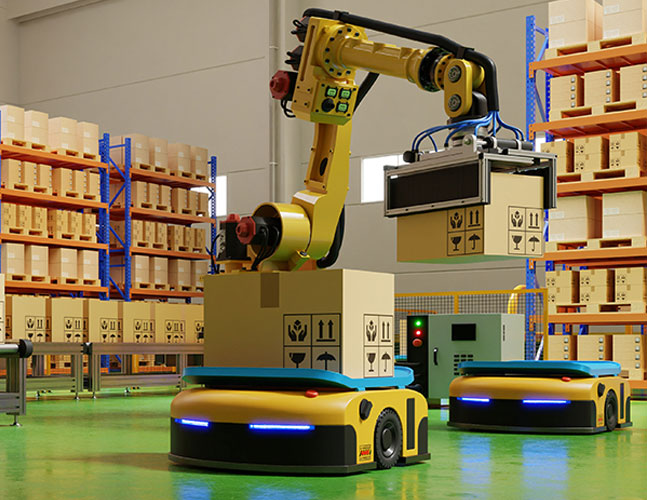
One of the most significant challenges in robotics is sensing in tight, demanding spaces. Consider the fork tips of an automated forklift—these components are thin, constantly in motion, and responsible for the most critical part of the operation: picking up loads. Standard sensors are often too bulky to be placed where they are needed most.
The UCT-10LCM addresses this challenge with a multi-layer 3D LiDAR design in an ultra-slim 20 mm profile, enabling integration in space-constrained areas such as near fork tips. By capturing data across multiple layers, it provides depth and elevation awareness—rather than a single, flat plane of detection.
This capability enhances both navigation and pallet handling. With 3D awareness closer to the point of interaction, the system can detect pallet misalignment or floor-level obstructions that could interfere with lifting. The result is improved pick accuracy and reduced risk of damage to goods or equipment—transforming automation from fixed execution to responsive, real-world decision-making.
Safety Without Compromise: The UAM-05LP
Safety is a non-negotiable pillar of industrial automation. In the past, safety often came at the expense of productivity—if a sensor detected a person, the entire system would stop. Modern safety laser scanner technology, such as the UAM-05LP, is designed to maintain both safety and operational continuity.
The UAM-05LP enables the configuration of flexible, multi-zone protection areas. A warning zone can be set to slow machine operation when a person approaches, while a protective zone initiates a stop only when necessary. These zones are fully configurable and can be adjusted based on the machine’s operation or speed.
This approach supports safe human-machine interaction without constant start-stop interruptions that reduce efficiency. By implementing intelligent safety scanning, operations can move beyond a binary “on/off” safety model to a more adaptive, decision-based approach—protecting personnel while maintaining throughput.
Smarter Obstacle Detection and Reduced Downtime
False stops are a hidden drain on warehouse productivity. Minor environmental factors—such as airborne debris or dust—should not cause an AMR to halt unnecessarily. Advanced AGV sensors are designed to filter out this type of environmental noise, focusing only on relevant obstacles.
Real-time sensing enables autonomous systems to navigate safely through dynamic environments. When AGV LiDAR detects an object in its path, the system does more than stop—it evaluates the situation. Is the object moving? Is there sufficient space to navigate around it? By making these micro-decisions in milliseconds, the system minimizes unnecessary downtime while maintaining safe operation.
This level of intelligence is also critical for specialized applications such as crane collision avoidance system. In overhead crane operations, the cost of a collision can be significant. Sensing technology that accurately measures distance and relative motion between moving assets enables the system to respond before a potential incident—helping protect both equipment and personnel.
Enhancing Reliability with Optical Data Transmission
When we think of “sensing,” the focus is often on lasers and light—but how that data is transmitted is just as critical. In moving or rotating systems—such as turntables, automated storage and retrieval systems (AS/RS), or overhead cranes—traditional wiring is prone to mechanical wear and eventual failure.
Optical data transmission provides a contactless communication solution. By using light to transmit data across a gap, it eliminates the need for slip rings or trailing cables that degrade over time. This approach improves overall system reliability while reducing maintenance requirements.
When the communication link is as reliable as the sensing system itself, decision-making becomes more consistent. Eliminating physical wear points helps prevent signal degradation or interruptions—ensuring the control system continuously receives accurate, high-quality data for real-time operation.
From Data to Decisions: The Path Forward
The goal of advanced sensing is not just to collect data—it is to enable better decisions. High-quality sensor data is the foundation for faster, smarter automation. When sensing is accurate and data transmission is reliable, the entire operation becomes more adaptable.
This shift allows facilities to move from rigid systems to environments capable of handling:
- Dynamic Obstacles: Navigating around moving people and equipment with confidence
- Complex Handling: Leveraging 3D awareness for precise tasks such as pallet picking with the UCT-10LCM
- Optimized Safety: Protecting workers with the UAM-05LP without compromising cycle times
As Industry 5.0 continues to evolve, selecting the right sensing foundation becomes increasingly critical. Whether integrating AGV sensors into a new fleet or enhancing an existing line for improved human-machine collaboration, the right technology enables a seamless transition.
Advanced sensing shifts the focus from simply controlling movement to understanding it. By transforming raw environmental data into actionable intelligence, it drives measurable improvements in safety, efficiency, and operational flexibility.
Ready to take your automation from detection to decision? Our team is here to help you identify the right sensing solutions for your application. Connect with our experts to get started.